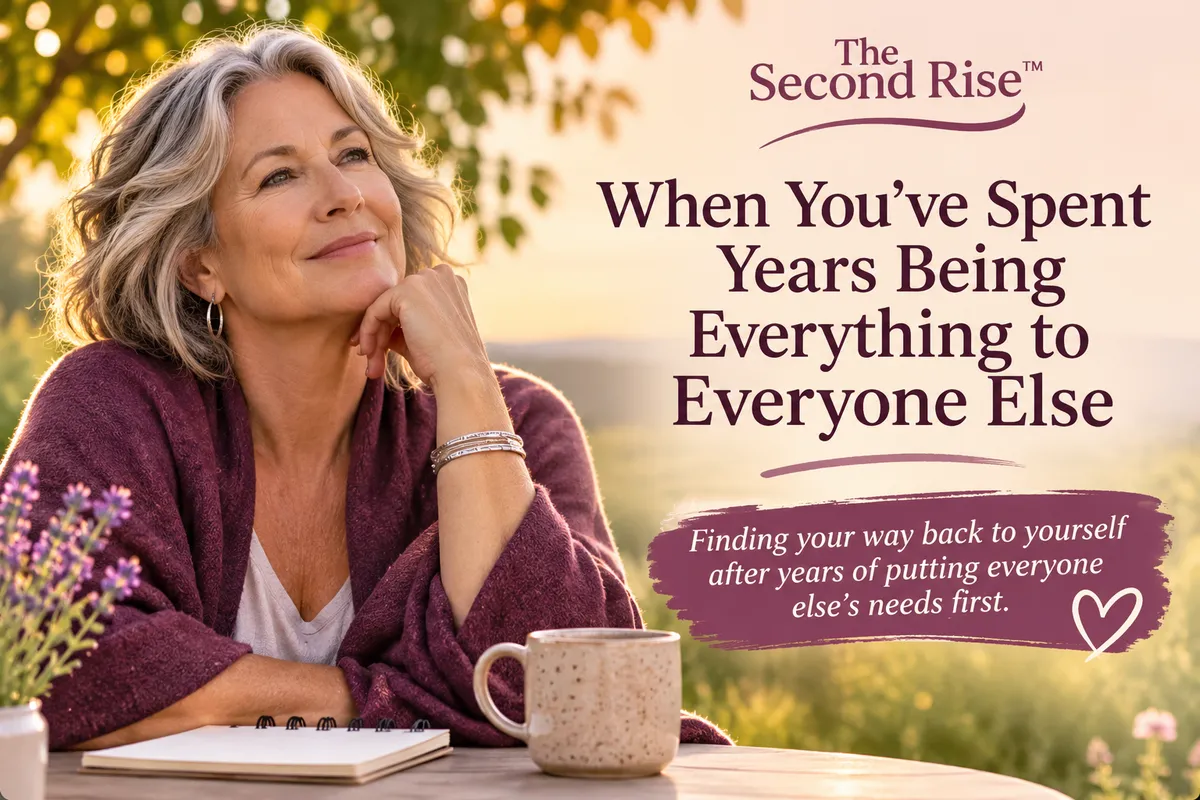
Finding Yourself Again After Years of Putting Others First
Finding your way back to yourself after years of putting everyone else's needs first.
Have you ever stopped in the middle of an ordinary day and wondered:
When did I stop asking myself what I wanted?
Not what the family needs.
Not what your partner wants.
Not what needs organising, fixing, paying for or taking care of.
What do you want?
For many women, that's a surprisingly difficult question to answer.
Not because they haven't lived full and meaningful lives.
Quite the opposite.
They've spent years raising families, supporting partners, building careers, running businesses, caring for parents and being the person everyone turns to when something needs doing.
And somewhere amongst all those responsibilities, their own needs have quietly moved further down the list.
Being capable can become its own trap
There's something I've noticed over my years in business and working with people.
When you're good at managing things, people naturally rely on you.
You're the organiser.
The problem-solver.
The one who remembers birthdays, makes appointments, keeps everything moving and finds a way through when things become difficult.
And often, you're proud of being that person.
There's nothing wrong with that.
But being capable doesn't mean you should have to carry everything.
And being needed isn't the same as feeling fulfilled.
Sometimes we become so accustomed to asking, "What needs to be done next?" that we forget to ask, "Is this still what I want my life to look like?"
Your roles are part of your life, not your whole identity
Mother. Wife. Partner. Daughter. Grandmother. Business owner. Employee. Carer.
These roles can bring enormous meaning and satisfaction.
But they aren't the whole of who you are.
You were a person with interests, ideas, preferences, hopes and dreams before you took on many of those responsibilities.
And that person hasn't disappeared.
She may simply have had very little room to express herself.
Perhaps your children have grown up and don't need you in quite the same way.
Perhaps your work no longer gives you the satisfaction it once did.
Perhaps you're thinking about retirement, changing direction or doing something for yourself.
Or perhaps life has changed in a way you never expected.
Sometimes we don't choose the beginning of a new chapter. Circumstances make that decision for us.
When the life you knew changes
Recently, I was attending a live show when I found myself sitting beside a woman I'd never met before.
We began talking, and she shared something that stayed with me.
She'd spent more than 30 years with her partner. They had married only a few weeks before he died from cancer.
She spoke about how frightening it had been to face life without him.
But there was something else she mentioned that I found particularly significant.
Her social world had changed too. She noticed that couples and other women didn't seem to include her in outings in the same way.
And after so many years of being part of a couple, she was left trying to work out who she was as an individual.
She told me it had taken close to eight years to begin finding that sense of identity again.
But what I appreciated was hearing how things were changing for her.
She said she was now finding it easier to live with herself and was feeling much better about her life.
She'd also begun supporting a younger family member who was going through a separation, offering him encouragement as he worked on rebuilding his confidence.
As I listened, I wondered whether being able to contribute to someone else's life was giving her a renewed sense of purpose too.
That conversation reminded me that finding ourselves again isn't necessarily about returning to who we used to be.
Sometimes it's about discovering who we're becoming.
And that can take time.
There is no deadline for rediscovering who you are.
Nor does finding happiness or purpose again mean forgetting the people and experiences that shaped your life.
We can carry our past with us while making room for something meaningful in our future.
You can love your life and still want something different
Not every woman reaches this stage because of loss or a major life event.
Sometimes it's simply a growing awareness that the life you've been living no longer quite fits.
And this is an important distinction.
Wanting more time, independence, creativity or personal satisfaction doesn't mean you're ungrateful.
It doesn't mean you don't love your family.
And it certainly doesn't mean you need to turn your whole life upside down.
You can appreciate everything you've built and still recognise that your needs are changing.
That's part of growing and evolving.
The woman you are today has different experiences, responsibilities and priorities from the woman you were at 25 or 35.
Why should you expect yourself to want exactly the same things?
Start noticing what gives you energy
When you've spent years focusing on other people's needs, reconnecting with yourself may feel unfamiliar.
You might not immediately know what you want.
That's okay.
Rather than demanding a grand answer about your purpose or your next chapter, start with something smaller.
Pay attention to your everyday life.
What do you look forward to?
What leaves you feeling drained?
When do you feel most like yourself?
Is there something you've been saying you'd love to do, but never quite get around to?
Perhaps it's studying something new, returning to an old interest, travelling, changing how you work or simply having more time that belongs to you.
And sometimes, as the woman I met reminded me, finding meaning may involve contributing to someone else's life in a way that feels right for you.
But purpose doesn't always have to involve caring for someone else.
It might come from learning, creativity, friendships, independence or simply enjoying your own company.
The answers don't have to impress anyone else.
They only need to matter to you.
Learning to make room for yourself
One of the challenges for women who've spent years being responsible for others is that making time for themselves can feel uncomfortable.
You might feel guilty saying no.
You might worry about disappointing someone.
Or you might find yourself explaining and justifying every decision.
But having personal needs doesn't make you selfish.
And setting a boundary doesn't mean you care any less.
It simply means recognising that your time, energy and wellbeing matter too.
You don't have to stop supporting the people you love.
You may just need to change how much of yourself you're giving away.
That might begin with a conversation, a small boundary or a decision to keep one commitment you've made to yourself.
It doesn't have to be dramatic.
You're not starting from nothing
Here's something I want you to remember.
All those years of caring, working, organising, learning and solving problems have given you experience.
You've developed judgment.
You've learned to adapt.
You've handled situations you once thought were beyond you.
You have skills and knowledge that may be so familiar to you that you no longer recognise their value.
Those experiences aren't wasted simply because you're ready for something different.
They're part of the foundation you can build upon.
Your next chapter doesn't require you to become a completely different woman.
It may simply be time to give more attention to the woman you've become.
Three questions worth sitting with
If any of this feels familiar, I'd encourage you to find a quiet moment and consider these questions.
1. What am I continuing to do simply because everyone expects me to?
Not every responsibility can or should disappear. But some expectations may be open to discussion.
2. What have I been putting off that genuinely matters to me?
It might be something practical, creative, personal or professional.
3. What is one small decision I could make this week that would give me more room to be myself?
Don't worry about finding perfect answers.
Just be willing to listen to yourself.
Sometimes that's where change begins.
Your next chapter belongs to you
There comes a time when it's worth looking at the life you've created and asking whether the way you're living still fits the person you are today.
For some women, that question comes after divorce, bereavement or another major life change.
For others, it comes quietly, after years of putting everyone else's needs first.
And sometimes it takes years before you're ready to explore the answer.
You don't need anyone else's permission to begin.
You don't need to have everything worked out.
And you don't need to abandon the people or commitments that matter to you.
You can make thoughtful changes, at your own pace, guided by your experience and what you value now.
Because after years of being there for everyone else, you deserve to have a place in your own life too.
And perhaps that's where your Second Rise begins.
Continue Exploring Your Second Rise
Rediscovering who you are doesn't mean leaving behind everything you've experienced. The challenges you've faced, the responsibilities you've carried and the skills you've developed are all part of the woman you are today.
You might also enjoy my earlier article, You're Not Starting from Scratch — You're Building from Experience, where I explore how your life experience can become the foundation for your next chapter.
A gentle place to begin
If you're wondering what you want from your next chapter but aren't quite sure where to start, I've created a free The Second Rise™ Assessment.
It's an opportunity to reflect on where you are now, recognise the strengths you've developed and begin exploring what matters to you moving forward.
Explore the free The Second Rise™ Assessment
Sharon Bremner is the founder of The Second Rise™ and a relationship-centred coach and mentor with more than 37 years of business experience.
